
How to wake up correctly?
- How to correctly awake?
- 3 easy exercises before getting up
- Who can follow these exercises?
- Conclusions
The way we awake each morning I very important, especially in cardiac patients and those who suffered a myocardial infarction. This happens because of the vagal influence on the nervous system - the entire organism during the sleep is encountering a total relaxation, with the dilatation of the blood vessels and a blood pressure collapse.
The way we awake in the morning can influence the blood pressure so much, that in some people a wrong and a sudden raising from bed may cause a severe hypotension and even induce a slight dizziness for a short of time.
The main reason this happens is because of the sudden move of the blood from the cranial part (brain) to the inferior organs and members.
How to correctly awake?
How to raise correctly from the bed and to avoid dizziness and your blood flow not to suffer? At this question I'll try to answer below and give you some practical advices.
- When woke up, open your eyes slowly and remember that today you won't jump from your bed as you may used to be. There are no wolves under your pillow to run from. Remember that this time you want to awake relaxed and calm, easy and taking your time to leave the bed with silent moves
- Stretch your legs, hands, don't force yourself to look at the window or direct light source like bras, or lamps, or even a cell phone, which also has a bright screen and will blitz your eyes. You may even prepare your room by the evening - close the window-shades, and all the lights
- The alarm clock is very stressful in the evening. Sometimes from a reflex you may jump from your bed in the bathroom at the thought that you could miss something important this morning. And this is not good, especially if you know your blood pressure is low or can easily go down. Even with a busy life - studies, work, you must find a few more minutes to idle a little in your bed, to wake up in slow moves, to accommodate your body to the new morning that has just came.
3 easy exercises before getting up
Follow these simple 3 exercises which in less than two minutes will return you back your necessary blood pressure and tonus to start a new day-
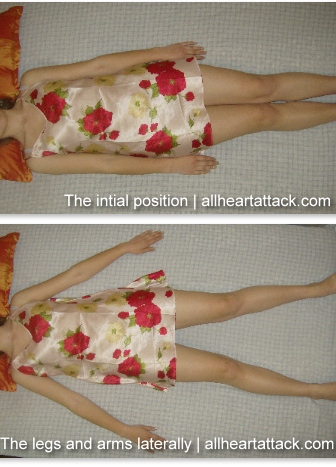 The initial position is with your hands and legs near the body. Then start a slow move deviating the legs and the arms at the same time from your body to laterals. Repeat this exercise 6 to 8 times
-
 Lying in the, bed put your arms along your body and start working just with the legs, flexing one by one in the knee articulation. As you can see in the photo, this is a very simple exercise, but efficient - it improves your peripheral circulation in the legs and this is important after a night when during the sleep the blood slowed in the arteries and veins. The aim of this exercise is to increase the muscle irrigation with blood and increase the heart-beats. Repeat it from 4 to 6 times.
-
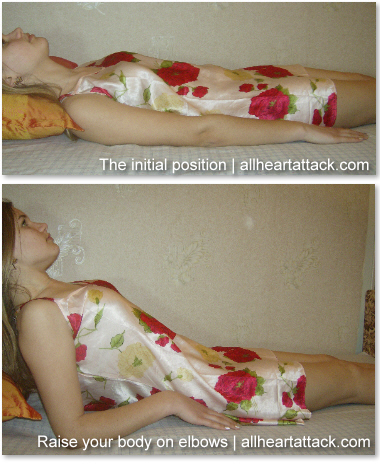 This exercise consists of raising your upper body and support yourself on elbows. Maintain this position for 5 to 10 seconds, and then lie down for other 5 - 10 seconds. Repeat this exercise from 3 to 4 times.
Who can follow these exercises?
Now, after finishing this set of three exercises you are ready to leave your bed. Incline on the on side of you body slowly, first put down your legs, then arms, look around for some seconds and stand up when you feel you are ready. Take your time, don't hurry. You can afford some 2 minutes every morning, just to be sure you decrease your chances of having a blood pressure fall.
These exercises are recommended not only to the patients with cardiovascular disorders. They can be used by anyone, because the risk of having a sensation of dizziness immediately after standing up is characteristic to many people. Sudden change of position is a stress situation both for our brain (the amount of incoming blood reduces), and for the heart (which must increase the rhythm to "raise" the blood which tends to flow downward in the relaxed vessels). This is a explanation why we feel that weakness sensation in the morning.
Conclusions
I hope these exercises will help you overpass your morning hypotension. Although these exercises don't impose any risks even for patients after 4 days after an Acute Myocardial Infarction (AMI), it is not recommended to be used by the patients which:- Suffer a recovery after a trauma
- Have a septic disease with bacterial infestation, scars, and skin ulcers
- Epilepsy, psychoses, mental disorders
- Persons with diabetes should be careful and apply these tactics only if they assume the risk of a hypoglycemic shock. The insulin values in the morning may be low and a physical constraint may lead to some unexpected reactions
- In pregnancy it's better to avoid any physical exercises that are not supervised by your doctor. Although it is very improbably that any complications may be induced, for your security, avoid these exercises
- If your doctor gave you some indications saying you shouldn't make any physical effort, then please follow his/her advices
Have a strong heart and beautiful mornings.
I hope my article will help you easier leave your bed in the morning.
-
New articles
- Blood clots -- who is at risk and how to prevent them
- Smoking -- a habit which puts big risks on your heart health overtime
- Pain in Heart Attack
- Pain in heart angina
- Death can be predicted by heart rate in patients with stable heart disease
- A superglue can improve the quality of life in heart patients recovering from heart surgery
- False heart attack - disease that may mimic a myocardial infarction
-
Popular articles
- The pain in heart attack - location, irradiation and common signs
- False heart attack - disease that may mimic a myocardial infarction
- Nitroglycerin -- a solution for the angina pains
- Nature of the pain in Heart Attack
- 10 signs of heart attack
- Pain in heart angina
- A superglue can improve the quality of life in heart patients recovering from heart surgery
Resuscitation
Cardiopulmonary Resuscitation (CPR)
How to help an unconscious with heart attack?
Prevent Heart Attack moving... in the bed - Free exercises
Calculate your BMI
Calculate your Body Mass Index, see if you are overweight or not
Download a Free ebook
 Understand better Heart Attack in 20 articles. Download a copy now!
Heart disease statistics
 1.5 million Americans suffer a heart attack each year (that's 1 heart attack every 20 seconds)
Emergency numbers
 Do not ignore chest pain or discomfort if you think you might have a Heart Attack. Find the emergency phone numbers worldwide .
 Women and Heart Attack
Read more on heart attack in women
Heart Attack in pregnancy
Cholesterol
Where does cholesterol come from?
Heart Attack Risks
10 signs of heart attack
What are the risk factors of heart attack? [video]
